
Guides · 8 October 2026 · 3 min read
A Christmas living room: choosing colours for a green tree or a white one
The tree is the biggest new colour to enter the house in December. Here's how to tie it to your sofa, rug and ornaments so the living room looks designed rather than crowded.
The tree is the addition we all can’t wait for, counting down the days until we decorate. But how do you get it right? Here’s how to tie the snowy little tree or the classic pine to your sofa, rug and ornaments — everything that will share your space and bring the magic of the festive season into your home!
Start from the room you have, not the ornaments
In December your living room already has a palette: walls, sofa, rug, floor, wood. The tree and the ornaments are the new colour layered on top. A simple rule: most of the room's colour (roughly 60%) stays as it is, the tree and the large elements take around 30%, and the remaining 10% is accents — baubles, ribbons, candles. When the decorations try to change everything, the room tires you out by the first week.
Before opening the boxes, look at three things: the sofa's undertone (warm, with a beige or yellow base, or cool, with a grey or blue base), the colour of the rug, and the light the room has in the evening. The rest follows from there.
The classic green tree
Green is already a strong colour, so the ornaments don't need to shout. A deep, dark green wants ornaments that reflect light — metal, glass. A lighter green with a yellow base wants deeper, lower-saturation colours around it, so it doesn't look neon beside them. Three combinations that almost always work:
Red and gold, the traditional one. For a more grown-up result, choose a deep red (burgundy, brick) rather than a bright red, and warm gold, not yellow. It suits beige, cream and camel sofas and wooden furniture.
Natural materials: wood, terracotta, copper, dried orange slices, pine cones, linen ribbon. It's the most earthy combination, and it's a cousin of the earthy palettes we're seeing on walls this year.
Blue and silver: the nighttime combination — navy, silver, white — gives a cooler, more elegant result and suits grey and blue sofas. Keep the tree's green dark; a yellow-green will quarrel with the blue.
The white (snowy) tree
A white tree is a blank canvas: it reflects light and accepts almost any colour, but it has two traps. First, it disappears against a white or light wall and a light sofa — it needs dark or saturated ornaments for its shape to read. Second, whites aren't all the same: many «white» trees lean cream and others lean blue. Work out which before choosing everything else, exactly as you would with a wall colour.
Silver, frost and navy: the «snowy» combination. It works with cool greys and blue sofas. If the room is warm, add some champagne or gold so it doesn't feel cold.
In the second photo the white tree stands in front of large windows: the abundant daylight gives it volume, and the blue accents — ornaments, velvet cushions, the tree skirt — keep it distinct against the light sofa and white walls.
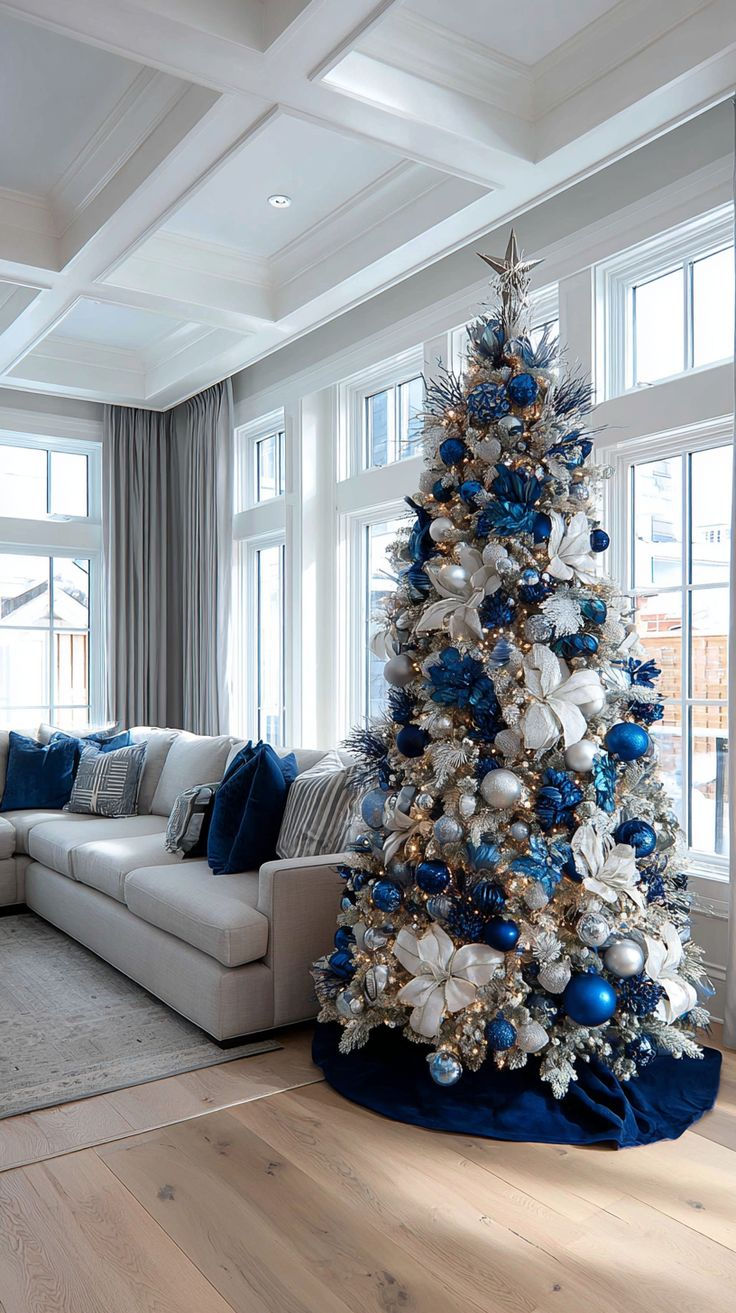
The blue and the soft grey of the sofa, with codes:
Champagne, ivory and powder pink: warm and soft. It suits beige and camel sofas and rugs in neutral tones.
Strong contrast: deep red, emerald or black with gold on a white tree. It's the most striking combination and the most demanding — keep it to two colours at most.
Let the sofa and rug lead
Beige, cream, camel (warm): green tree with red-and-gold or natural materials; white tree with champagne and powder pink.
Grey (cool): green tree with silver, white and one touch of deep red; white tree with silver and navy. If the grey is warm (greige), go with the warm combinations.
Navy or petrol blue: green tree with gold and copper; white tree with silver or gold — the deep blue makes both stand out.
Dark brown, leather or charcoal: green tree with red, copper and gold; white tree with gold, for a little glam.
White or very light: a white tree will vanish. Either choose green, or give the white tree dark ornaments.
Green sofa: a green tree beside it can look like two different greens arguing. A white tree with gold and red is safer.
There is also the opposite approach: lean into harmony. As you can see in the first photo, a green tree can live beside green sofas when the greens have depth and the accents — ornaments, cushions, throws — are deep red. Red is green’s complement and makes both stand out.
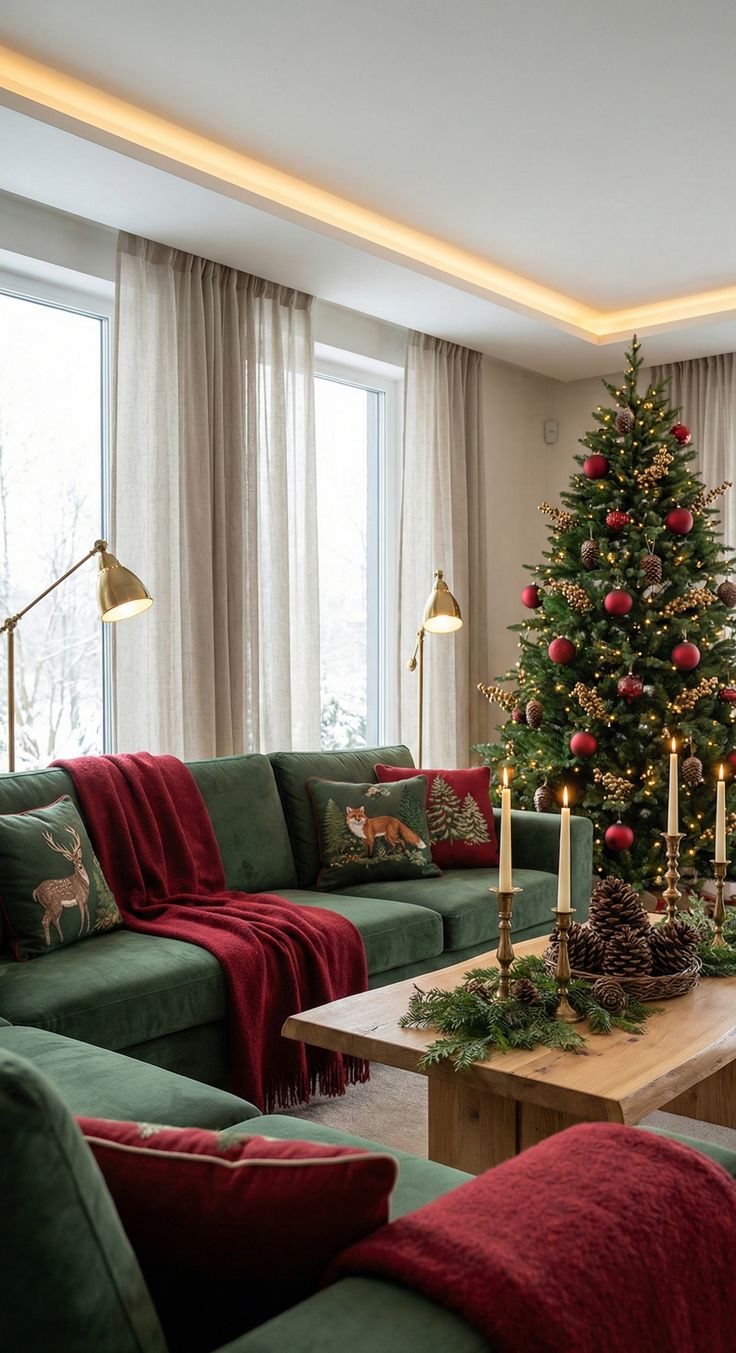
The photo’s combination, with codes from the fan decks in our app:
The rug is the easiest guide. If it has colour or a pattern, take two colours from it and repeat them in the ornaments. That way the tree looks like it belongs to the room rather than having been added to it.
How to tie the ornaments together
Two or three colours and one metal — no more. Give each colour two finishes (matte, glossy, glitter): the same red in a matte and a glass bauble adds depth without adding «another» colour. Large ornaments go on first, deeper inside the tree; small ones toward the outside. And repeat the colours around the room — a cushion, candles, a garland — in at least three places, so the eye reads one palette.
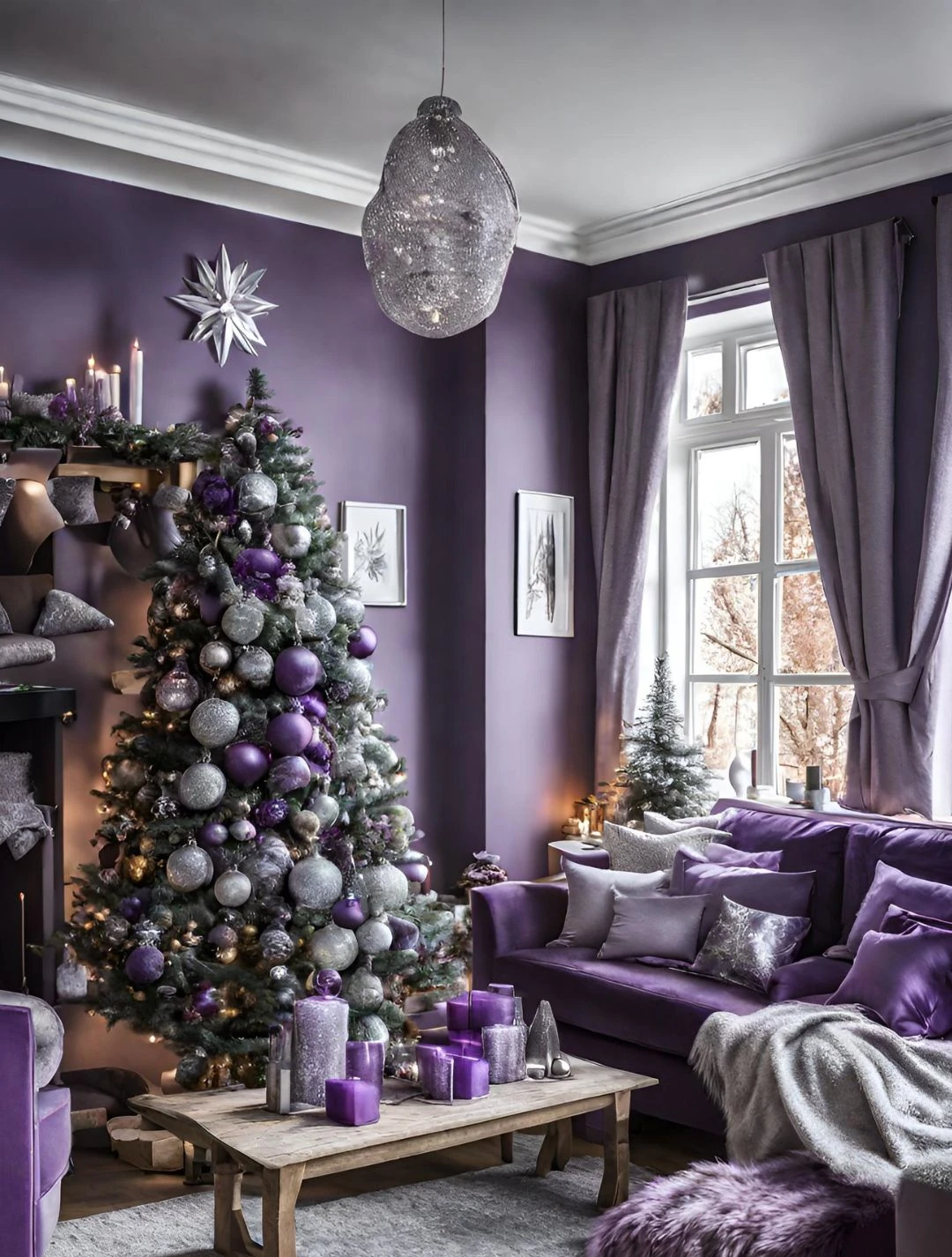
The third photo shows the same logic in practice: a green tree with white baubles and garlands leaning toward grey, and one purple repeated at three intensities — strong on the ornaments, sofa and cushions, two tones softer on the wall, and lighter still on the curtains.
Lights count as much as ornaments. Warm white brings reds and golds closer together, while cool white gives an icy result: it suits silver and blue, but makes a warm room look cold. Don't mix the two on the same tree.
Find the right lighting
The same tree looks different depending on the light in the room, so lighting deserves to be planned like the colours. Some living rooms need low-intensity, yellow (warm) light, which calms the colours and gives a soft atmosphere in the evening.
Other homes, with large windows and strong morning light, can carry bolder combinations: there you can enjoy your coffee in front of the fireplace with stronger colours, because daylight balances them.
Count everything that stays on all the time too: illuminated signs (stars, “Merry Christmas”) and the tree lights change the colour you see, just as the room’s bulb does. Try the tree with the lights on and off, morning and evening, before hanging the last ornament.
ChromaGain Editorial · ChromaGain guides are updated as painting practice and colour trends change.